Thursday, May 27, 2010

Celebrating Literacy and People

Submitted by Jaclyn Paul, Program Assistant for Development and Administration


Last week, I was asked to wear my photographer hat and volunteer my services at our 20th Annual Literacy Celebration.   More than 160 program volunteers, current and former staff, learners, and partners came out to recognize the wonderful work GHCC's Adult Literacy and ESOL (English for Speakers of Other Languages) Program is doing.  I'd like to share a few of my favorite moments from the event in the form of a short photo essay.

20th Annual Literacy Celebration

20th Annual Literacy Celebration

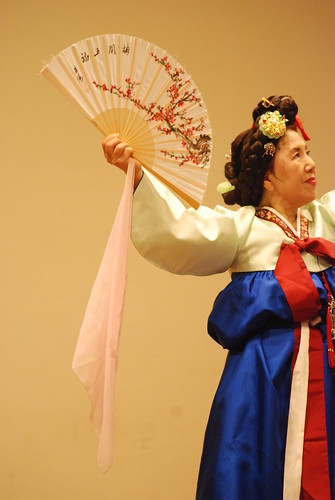
I felt fortunate for the opportunity to see these heartfelt performances from the Greenmount Senior Center Dance Team.

20th Annual Literacy Celebration

Without meeting them in person, it's hard to convey just how strong the tutor-learner bond can be.  Seeing tutors speak about their learners—and vice versa—brought home to me how much these pairs become like family, completely invested in reaching a shared goal.

20th Annual Literacy Celebration

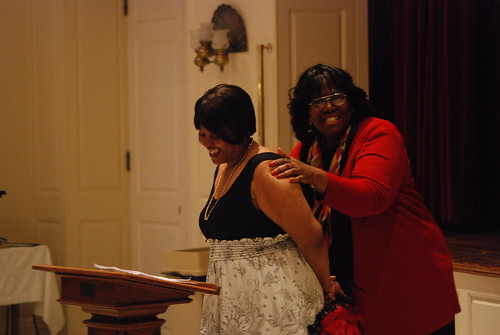
The first photo doesn't do it justice, so I just have to highlight the butterfly wings learner Ruby used to represent the changes she's undergone in her life since coming to the Literacy Program.

20th Annual Literacy Celebration

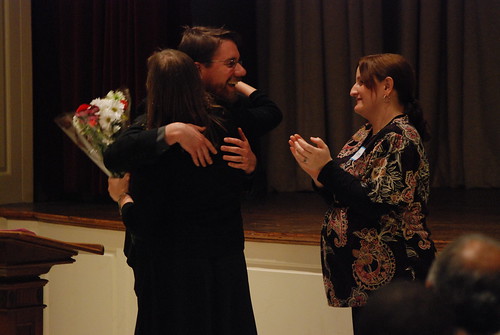
Our VISTA members have shared a lot of stories on this blog lately, but sometimes we forget how much impact they have on our staff.  Here, Special Literacy Projects VISTA Cyndel Taylor (shown receiving flowers) receives a big thank you from Program Director Todd Elliott and Assistant Director Kim Bosworth.

To see more photos from the evening, check out our albums on Facebook or Flickr.

Thursday, May 20, 2010

VISTA: A Legacy of Service

Throughout April, we heard a number of stories from current and former AmeriCorps*VISTA members.  VISTA is a national service program dedicated to eradicating poverty in the United States.  VISTA members sign on for a year of full-time service, receiving a modest stipend to offset the basic costs of living.  Here, GHCC's VISTA Supervisor shares what he learned from his recent experience at a reception for the 45th anniversary of VISTA in Washington, DC.

We are still recruiting VISTA members to serve at GHCC beginning this August!  If you would like to serve, visit our website for details.

Submitted by Tyson Smith.

I’ve served as GHCC’s VISTA Supervisor for about 18 months now.  Although my role is pretty administrative—managing paperwork, attending meetings and so on—I have developed a real affinity for the AmeriCorps*VISTA mission.  There’s something really inspiring about national service, and even though I’ve never taken my turn to serve the country in this way, I’m glad I’m in a position at GHCC where I can support the individuals who are serving.  That’s why, when I received an invitation to attend a reception for the 45th Anniversary of VISTA in Washington, DC, I gladly accepted.

At the reception, officials from the Corporation for National and Community Service (CNCS)—the government entity that runs VISTA—including CEO Patrick Corvington and Acting Director Paul Davis, thanked former VISTA members and praised the spirit and national impact of VISTA over the past four and a half decades.  Hyepin Im, of the CNCS Board of Directors, spoke about VISTA members in recent years whose work had garnered millions of dollars to support impoverished families and communities impacted by the housing market collapse and economic crisis.  Clearly, VISTA has become an integral part of our nation’s strategy for fighting poverty on many levels.

What I found most impactful, though, were the stories shared by three guests of honor who have had a lifetime of experience with VISTA.  Lynda Robb, daughter of Former President Lyndon Baines Johnson, spoke about the day her father launched the VISTA program and the lunch she attended with the very first group of 20 VISTA members. 

Senator Jay Rockefeller from West Virginia spoke about his year of VISTA service over 40 years ago in the Appalachian Mountains, and of the great impact that experience had on the course of his life. 

Maybe most impressive was the story that Representative Gwen Moore from Wisconsin shared.  Rep. Moore was a single mother living on welfare in Milwaukee when her neighborhood applied for VISTA funds to establish a credit union in their community.  She was encouraged to work on that project as a VISTA member, and as a result Rep. Moore became very well educated about finance, lending and other money matters.  Rep. Moore was honored as the VISTA of the Decade for 1976-1986.  Years later, she is sitting on the House Finance Committee. 

Sometimes we think of VISTA as a means to an end: to build a program, to address an issue, to fill a need.  What I learned last Wednesday was that VISTA is much more than an opportunity.  VISTA is a legacy of service.  It can change the course of lives.  VISTA is an incredible way to make a difference in the country, and in one’s self.  I am honored to be a part of this movement and I am so excited to share this experience with the lucky 10 individuals who will join GHCC’s new VISTA team this fall.

Monday, May 17, 2010

Neighborhood Walkers: Building Community & Fighting Crime

Citizens on Patrol (COP) groups are a great way to socialize with your neighbors, learn more about your neighborhood, and promote a sense of solidarity in your community.  COP walkers meet on a regular basis to walk through their neighborhood together, giving neighbors a friendly hello and making a note of anything in need of repair or attention.  Walkers keep an eye out for potential code violations, sanitation problems, vacant homes, abandoned vehicles, and more.


Want to know more about how a COP group can get started in your community?  GHCC is hosting a Citizens on Patrol and Neighborhood Walkers workshop on Thursday, May 27.  Join neighborhood walkers and Northern District Police officers at 7:00 p.m. at our offices at 3503 N. Charles Street to find out how to start a group of your own.  Click here for a printable flyer.


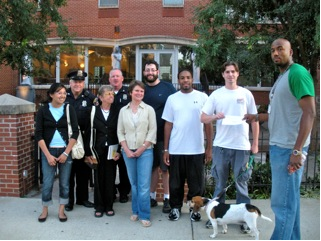
Here, Joe Stewart -- one of the residents who started Walking Waverly -- shares a little bit about his experience.

Walking Waverly came out of a meeting of Better Waverly Community Organization’s Quality of Life Committee a few years ago. Nameless at the conception, it began as a suggestion that committee members go outside and see how things were going on warm evenings, when residents gathered on corners, porches, sidewalks, and yards in response to complaints about inconsiderate behavior interfering with others’ peace and quiet.

Here would be a chance to observe what was happening. Maybe it would serve to calm things down.  At the very least, it would demonstrate representatives of the community organization were taking an active interest in matters at the block level.  Notice went out after picking a date, time and location to launch a stroll through the neighborhood.

Launched like a trial balloon on a Wednesday one spring evening by a few residents, Walking Waverly took on a life of its own. Before long, police officers from Northern District, City Councilwoman Mary Pat Clarke, and representatives from various city agencies were tagging along. Walkers greeted whoever was outside, introducing guests from the city to residents on their blocks.

Walkers brought their dogs along. New neighbors joined and learned things about the neighborhood they didn’t know. It was rewarding to be strolling with others, visiting and viewing the neighborhood together in each of the four seasons, with holiday decorations or different flowers in bloom. The commercial corridor was intentionally included. This allowed walkers to interact with merchants and to enjoy the shop window displays.

When it started getting darker, a decision was made to walk an hour earlier during fall and winter months.

What made it work? Leaders showing up regularly, posting ongoing notices, sticking to a schedule rain or shine, sleet or snow, and promoting special guest walks all helped.

What made it safe? Being a neighborly stroll where everyone along the way got greeted, not being confrontational or assuming responsibilities belonging to the police, and having “Walking Waverly” embroidered caps for those who wished to wear them.

Challenges we faced? It is continually difficult getting residents involved in community activities. Chapters could be written speculating why that is. However, it is important to remember a few dedicated people can make a difference and as long as participants remain neighborly, upbeat and willing to show up, Walking Waverly will serve a role in the community.

Walking Waverly

Tuesday, May 11, 2010

University of Maryland Social Work & GHCC

Each year, GHCC hosts a Masters in Social Work (MSW) intern at our office.  This year we have been lucky to have Sarah Rogerson, who has taken a moment to share her story with us as she prepares to graduate.  We'll miss you, Sarah!


Submitted by Sarah Rogerson

Carolina is where I call home.  I was born in Raleigh, NC, and spent six years of my childhood in Israel with missionary parents.  We came back to the states for my teenage years and lived in Murrells Inlet, just south of Myrtle Beach.  Since my family’s always been fairly mobile, it came as no surprise to them that I decided to move to Baltimore after coming home from my two-year volunteer stint in Malawi, Central Africa.  I really think it’s all this moving around that helps me adapt in personal, academic, and professional life.

A scholarship to study social work at the University of Maryland, Baltimore (UMB) piqued my interest in the city.  The scholarship was offered through Peace Corps Fellows, a program for returned volunteers.  Since my bachelors degree is in social work from Winthrop University (outside of Charlotte), I was awarded credits toward advanced standing status at UMB for their social work masters program, allowing me to complete my masters in one full year.  I was also drawn to this program in Baltimore because it has a macro option, focusing on management and community organizing.  Always up for a challenge, I’d been looking to expand my experience in the urban sphere.  South Carolina and rural Malawi are laid-back areas, so I was ready for a diverse, fast-paced, action-packed city.  Enter Baltimore.

Once I arrived, I had to choose between two field placements for my MSW (Master of Social Work) internship.  I chose GHCC because of the immediate warmth I felt upon entering the office and the historically strong community connection.  I knew exactly what kind of experience I wanted: a closer look at non-profit management concurrent with hands-on organizing.

I got everything and more at GHCC.  Harmoniously, several tasks I undertook here with this well-established community organization fell in line with classes I took at UMB.  As I studied social action, I was able to join with the Baltimore Education Coalition alongside a multitude of reputable organizations in advocating for full funding for quality education in the city.  My program management class gave me the knowledge to contribute meaningfully to the strategic planning team with key board members and staff.  Finally, my community organizing class gave me the skills to help organize a parent group at the Barclay School.

All of these broad community issues are ones GHCC tackles on a daily basis, making it one of the most unique and competitive organizations of its kind in Baltimore.  If that isn’t enough, the friendly staff have become like a family to me – one I will sorely miss!  

Every aspect of my work at GHCC, though not always planned or perfectly executed, has contributed to the career and personal path I will follow.  Grounded now in community non-profit experience, I feel well-equipped to find a social work job that incorporates these elements.  As I complete my degree program and internship at GHCC, I am grateful for the opportunity to have learned so much from such a competent, driven team of staff dedicated to the continuous improvement of Baltimore City.

Wednesday, April 28, 2010

York Road Alternatives for Youth (YAY): A Peaceful Response for a Better Neighborhood

Since 2000, GHCC's Youth Programs increased the availability of positive activities for Greater Homewood youth by building partnerships between schools, communities, and youth service providers to foster an integrated approach to meeting youth needs.  GHCC's established repuation as an intermediary enables our program to serve as a networking resource to promote common solutions.  Our current range of programming works with local youth providers and institutional partners to facilitate cross-sector collaborations and coordinated efforts to maximize and expand the reach of programs for underserved youth. To learn more about our youth programs, click here.

Submitted by Rev. Heber Brown, III

As the Summer of 2009 prepared to make its entry, the Govans community in north Baltimore experienced a rash of violence that unsettled many of our residents and neighbors.  Govans isn’t regularly featured on the nightly news for incidents of crime, but last summer was a reminder that no community is immune to acts of violence.  

On May 31, 2009, Joseph Woah-Tee, long-time Baltimore resident and owner of the Gaimei Nangbn Multi-Purpose Neighborhood Center in the 4300 Block of York Road, was killed in a robbery attempt at his Center.

A little more than two weeks later and less than one mile away, a young man in his late teens was killed in what the Baltimore Sun describes as a raucous “street fight between several people.”  The young man was stabbed and died about an hour later at an area hospital.

A couple of shootings occurred on the Alameda and Old York Road in July 2009, and two months later on September 11, a drive-by shooting occurred at York Road and Radnor Avenue.  Eight gunshots sliced through the air of that night and when the smoke cleared, two bodies were laying on the ground in the front yard of Patrice Brown – my mother.  Bullet casings decorated the cement and bullet holes pierced the walls of the American Friends Service Committee Building across the street.


In response to these shootings, a coalition of community members from all walks life gathered themselves for Prayer and Peace Vigils.  People of Faith and Conscience – from local churches, organizations, and the surrounding community – gathered to ensure that violence would not get the last word in the communities along the York Road Corridor.  
They participated in public actions for peace on two occasions: once on Sunday, July 19, 2009, beginning at the intersection of York Road and Woodbourne, and again on Sunday, October 11, 2009, beginning at the American Friends Service Committee and continuing along Radnor Avenue.

Building on the momentum of two well-supported public actions, conversations ensued about what proactive steps could be taken to prevent violence.  A diverse coalition and subset of the larger group began to meet, eventually coming up with the idea to have churches make their buildings and resources available on a weekly rotational basis to youth recreation on Friday nights calling the initiative: Y.A.Y.! It’s Friday.

In January 2010, this effort began with Pleasant Hope Baptist Church and in subsequent weeks moved to Govans Presbyterian Church and St. Mary’s of the Assumption Catholic Church – all churches along York Road.  A few months later, Holy Comforter Lutheran Church signed on as a host site as well.  Youth from the churches and the community have come together not only to play board games, cards, and Nintendo Wii, but have also shared in a review of Dr. Martin Luther King, Jr.’s “I Have A Dream” speech, had an Open Mic Night to share their talents, and had a forum on education equality in Baltimore City.

The gracious donations of the participating churches, partner organizations, and supportive neighbors have given Y.A.Y.! It’s Friday a promising start.  

As Summer 2010 is rapidly approaching, Y.A.Y. is preparing to ramp up our efforts, recruit more host sites/partner organizations, and reach a broader segment of community youth.

If you are able to lend your support to this effort with space, donations, time, or in some other way, we would love to hear from you!  Please contact Gary Gillespie as (443) 847-8989.

Tuesday, April 27, 2010

VISTA Spotlight: Andrew Stiller


Know someone interested in making positive changes in the world? GHCC is seeking qualified candidates for our nationally-renowned AmeriCorps*VISTA program.  Sign on for a year of service with us and receive health benefits, a modest living allowance, and an end-of-service education award.  We have 10 positions available to start in August 2010 in the areas of improving public schools, strengthening neighborhoods, and adult literacy.

We'll be featuring several VISTA stories in the coming weeks to raise awareness of national service.

Want to know more? Visit our website!

Submitted by Andrew Stiller

I never thought my time as a VISTA member would land me in front of a room of civil servants while being webcast live across the United States. But then again, I didn’t really know what to expect.

Though my parents tried to instill a sense of civic pride and responsibility in me, it didn’t really stick until I got to college. Community service was part of my middle and high school curriculum, but we never embraced it because it was forced upon us. Teenage angst and rebellion almost required that I scoff at being forced to clean streets.

Luckily, that all changed. As an undergraduate at Dickinson College I joined the event planning organization, a service-oriented club called the Keystones, and a traditional Greek fraternity. Surprisingly, I had a better service experience motivating the Greek men to roll out of their beds for philanthropy on Sunday morning than I did with the Keystones. I realized I could affect more change by motivating and teaching others. This was my philosophy throughout college.

After graduation, I was applying for policy-oriented jobs and anything else I could find. I was really lucky to be turned on to the AmeriCorps* VISTA program, and when a position opened up at GHCC, I jumped at the opportunity. VISTA reflected the ideals and methods I adopted in college.

My role as Community Connections Coordinator at GHCC immersed me in a Baltimore City public school community, working with parents and administrators at the school and a variety of partner institutions in the neighborhood. It became apparent early on that true success would be measured by how much buy-in I could get from the parents and the community. A large part of my responsibility would be motivating parents, churches, businesses, neighborhood institutions, and local colleges and universities to invest in Waverly Elementary/Middle School.

I had an opportunity to articulate my experiences when representatives from the Department of Education and the White House’s Center for Faith-Based and Neighborhood Partnerships came to Waverly to discuss partnership building. I don’t remember saying a lot, but it must have stuck with them. A few months later, I was asked to give a presentation on my role as a VISTA member to the Department of Education in Washington, D.C. A briefing had been scheduled to discuss the possible collaborative efforts between the Department of Education and the Corporation for National and Community Service (CNCS). As a VISTA member working primarily with schools, I was located at the epicenter of this relationship.

I felt really honored to present on my VISTA experience. I found that the hardest part was limiting the length of my speech. GHCC’s VISTA members wear many different hats on a daily basis: organizer, capacity builder, mediator, teacher—the list is almost limitless. It was really difficult to put it all these amazing experiences into words. I worked on my speech up until the night before, trying to find the right word to express how it felt to see a parent step up to participate at the school.

When I spoke, though, I was confident. The audience was attentive and after two PowerPoint presentations from officials at CNCS, I think my firsthand experience was a useful counterpoint. I spoke about the day to day things, my major accomplishments, and ways any VISTA member can positively change a school. Regardless of my pre-speech jitters and what I had written down, I found that speaking about my VISTA year was actually quite easy. I think the reason is simple: I became a VISTA to help motivate others, yet it was their efforts in return that motivated me even more. I am now just as invested as anyone else in Waverly Elementary/Middle School and its surrounding community. I hope that means my job has come full circle. 

Friday, April 23, 2010

VISTA Spotlight: Ashley Wallace

Know someone interested in making positive changes in the world? GHCC is seeking qualified candidates for our nationally-renowned AmeriCorps*VISTA program.  Sign on for a year of service with us and receive health benefits, a modest living allowance, and an end-of-service education award.  We have 10 positions available to start in August 2010 in the areas of improving public schools, strengthening neighborhoods, and adult literacy.

We'll be featuring several VISTA stories in the coming weeks to raise awareness of national service.

Want to know more? Visit our website!

Submitted by Ashley Wallace

I want to share my experience this year as an AmeriCorps*VISTA because I believe stories like mine help support and promote national service programs as central to the professional development of young Americans.

In May 2009, in what is now being called the worst economic climate since the Great Depression, I graduated from the University of Wisconsin-Madison with a Masters of Urban and Regional Planning. I wanted to diversify my professional planning experience and leave my humble Midwestern roots behind for a more progressive and challenging urban environment. I focused my job search on the Mid-Atlantic region — having lived in Wisconsin for seven years, I was ready for milder winters.  A few professors encouraged me to consider Baltimore for its extraordinary revitalization efforts.

My job opportunities soon began to seem very limited. The job openings I did find required more qualifications and years of experience than I had. I was competing with thousands of applicants who had resorted to applying to jobs they were overqualified for. My connections on the East Coast were few, so I began to broaden my search. I knew I wanted to work at the local level, and I already had a strong background in volunteering and a passion for community service, so I started to consider AmeriCorps*VISTA. It seemed like a great way to reach my goal of relocating to the Mid-Atlantic and working with a grassroots organization.

Keeping that goal in mind, I limited my search to VISTA positions with a connection to urban or neighborhood planning and revitalization.  I came across a position with the Central Baltimore Partnership (CBP) that focused on neighborhood and economic revitalization in four neighborhoods adjacent to the Penn Station. My educational and professional background in planning and community service drew me in, and when I was offered the position in the second round of phone interviews I accepted it on the spot.

I had concerns that although CBP focused on locally based revitalization, my skill set as a planner wouldn’t necessarily be utilized. Ultimately, however, I knew I would gain valuable exposure. Even if I would not gain urban planning experience in Baltimore, I knew it could open doors for me in the future.

I was right. The Executive Director of CBP, Joe McNeely, is a nationally recognized community organizer and he encouraged me to utilize my planning skills by reorganizing and redefining my role to fit my skill set and interests. I took on the responsibilities of community planning: integrating land-use and transportation planning with community-based engagement to improve the built, economic and social environments of communities. I have filled a gap that the CBP needed filled and I have learned a lot about Baltimore and its potential.  I have also fallen in love with its historic architecture.

About 8 months into my VISTA year I expressed interest in staying on with CBP at the end of my service. Soon after, conversations began about a salaried position for a community planner at CBP. I was officially offered a position a month later, securing my chance to stay in Baltimore and establish myself here professionally.

My VISTA year has been more than just a year of service. It was an opportunity of a lifetime to relocate to a major city, certain of my job security for the upcoming year, and experience a new and different place. I have learned about urban poverty, the challenges of community organizing, and the importance of community-based planning and economic revitalization.

VISTA has given me an opportunity to gain hands-on experience working with a progressive local nonprofit that is leading in the field of neighborhood revitalization. My experience as a national service volunteer has solidified my professional commitment to both public service and work in the nonprofit sector. What more could I have asked of my country during this year of service?